

On Wednesday in Atlanta, Argentina were trailing England with the clock running out — until Lionel Messi set up both goals, a long-range strike for Enzo Fernández and a stoppage-time cross for Lautaro Martínez, to send the defending champions through to a second straight final, 2–1. On Sunday at MetLife, at thirty-nine, he plays for the trophy a third time, in almost certainly his last World Cup: the all-time World Cup leader in both goals and assists, top of the Golden Boot race on eight.
The biggest sentimental story this sport has. And on the run that made it loudest, his card market went quiet.
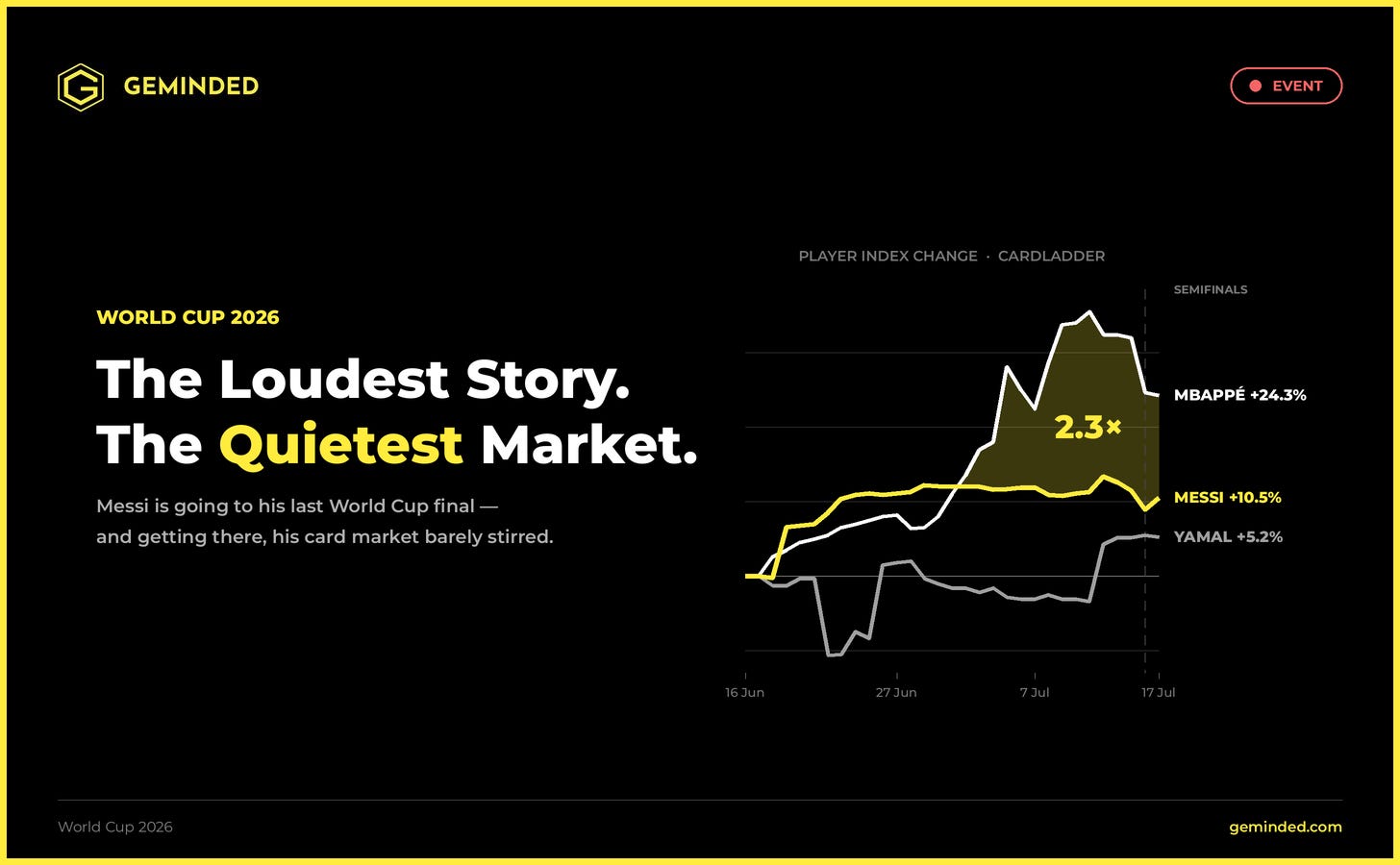
Three names still carry a real card market into the final weekend — Messi, Lamine Yamal and Kylian Mbappé. Above are their Card Ladder indexes since the group stage opened on June 16.
Start with the tier that’s climbing fastest — and note that it isn’t the finalist. It’s the Rerun, not the Last Dance: Mbappé’s index is up 24.3% on the month, more than double Messi’s — the Rerun ahead of the Last Dance again, as in June. But that gap is mostly plumbing, not sentiment. Mbappé is twelve years younger, and his index — 13,050 to Messi’s 148,245 — is more than ten times smaller, where the same percentage move comes far more easily. The Rerun outrunning the Last Dance isn’t the market turning on Messi. It’s a small, young base doing what small, young bases do.
The Messi story is in his own line. It opened the group stage at 132,397 and barely moved for two days — 133,764 on June 18 — before the goals repriced it: 142,903 by June 19, a 6.8% jump in a single day, and on to 150,464 by June 30 (the opening hat-trick against Algeria, then the two goals against Austria that broke Klose’s all-time record). It touched a July high of 152,047, then gave it back: 146,196 by July 15 as the semifinal approached, and 148,245 on July 16 after the win — still short of the 150,464 it had reached at the end of June. Argentina survived four straight knockout scares to get here — extra time against Cape Verde, a comeback from two goals down against Egypt, extra time again against Switzerland, the late turn against England — and the index came out the other side lower than it went in.
The group-stage goals moved his market; reaching the final, so far, has not — and the run only ended a few days ago, so any repricing may still be days away. What Sunday adds on top — the trophy, likely the Golden Boot — is the real test.
Two ways to read it
Priced in. The market did its Messi buying while he was scoring freely, in the group stage; by the knockouts there was little left to pay for. The story is already in the number, and Sunday won’t add to it.
Not yet. The other read — and it’s my read, so weigh it that way — is that the knockouts priced survival risk, not upside. While Argentina were grinding through games that kept going to the wire, the index actually dipped; nobody chases a farewell premium into a result that isn’t certain. On that read the premium doesn’t get paid during the noise. It gets paid later, once the career is closed and the supply of “the last one” is fixed for good.
Neither settles before Sunday. But the dip into the semifinal is the tell: this market has been pricing the risk that Messi goes out, not the reward if he wins.
If Argentina win
Here’s the part the trophy talk skips. A Messi World Cup wouldn’t create scarcity — it would release supply. The top of his market is already deep, and already moving: since February, 123 Messi one-of-ones have changed hands above $5,000 — 46 of them in the five weeks of the tournament alone. The pace of high-end sales has roughly doubled on attention, and it hasn’t needed a final to do it.
So the reflex that a win sends limited Messi cards to the moon has a problem: the sellers are already here, and a lifted trophy brings more of them out, not fewer. Peak attention is also peak supply. Prices can still rise — but on this evidence, less violently than a holder pricing in a coronation might assume.
Before Sunday
If you’re holding, this is the most attention Messi’s cards will see before he retires — and, if Argentina win, the most sellers you’ll be up against, too. Selling into today’s attention and selling into a post-win flood aren’t the same trade; which one you want is a call to make before Sunday, not after. If you’re buying, you’re buying after the month’s move, at the top of the story, with the trophy undecided. If you’re watching, the number that matters isn’t the scoreline — it’s what the index does in the week after the whistle, once the attention starts to drain.
The story could not be louder. The market stopped listening weeks ago. What Sunday settles isn’t which of those was true — it’s which one the week after believes.
Do you buy the farewell — or sell into it?
Reply directly to this piece — I read every response.
The full post-tournament reckoning lands after the final.
— Geminded