

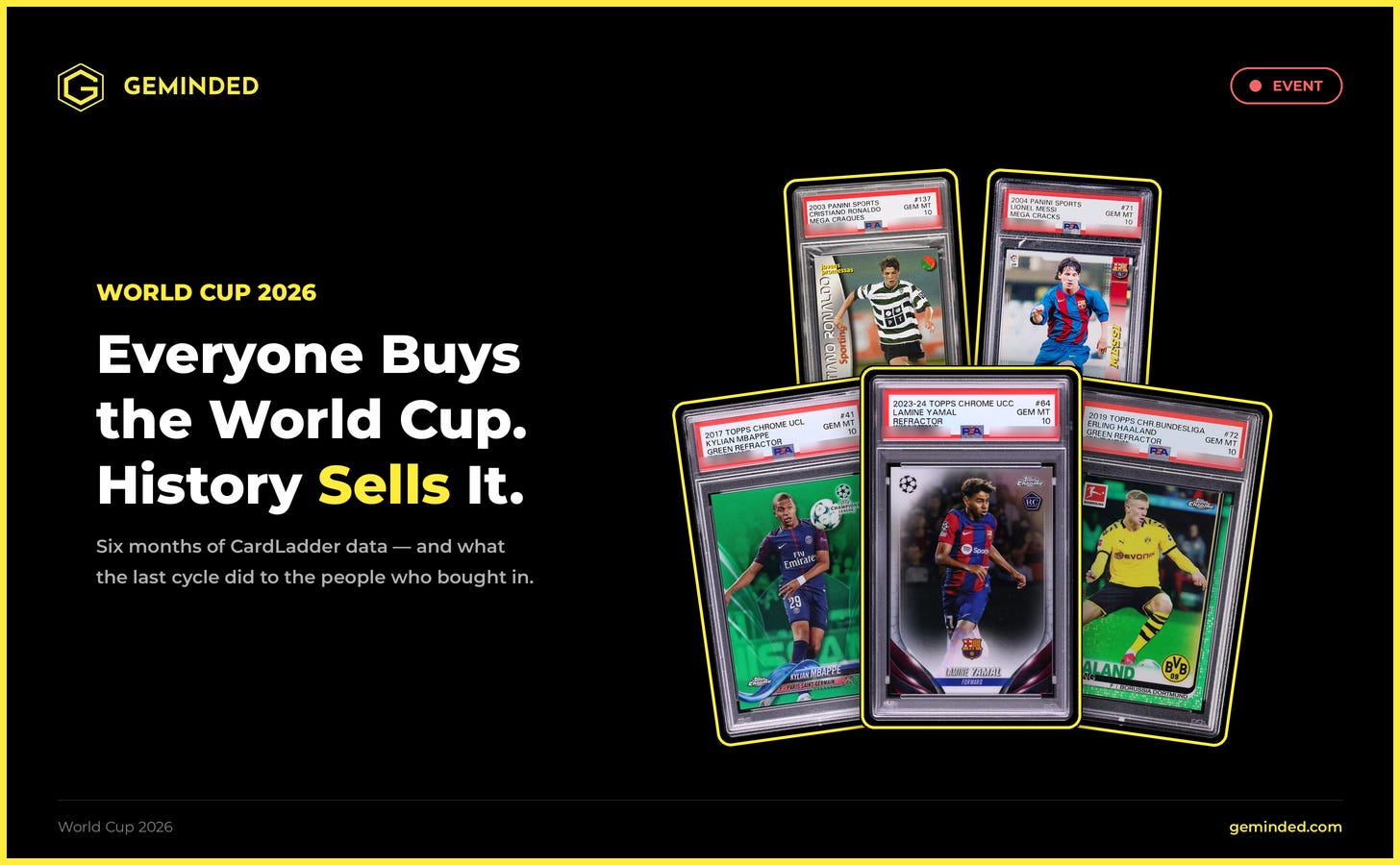
On Thursday night, June 11, the biggest World Cup in history kicked off at Estadio Azteca: 48 teams, 104 matches, three host countries. The following night, the United States take the field in Los Angeles. And the card market is running flat out with the tournament — the soccer index is up 10.6% over the past six months, and the shelves are buckling under fresh World Cup product.
Everyone is buying. This piece asks two questions: what exactly is being bought — and what happened to the people who bought last time.
The Biggest Stage, a Different Regime
On paper, 2026 is the biggest opportunity soccer cards have ever been handed: a home tournament on the American market and an audience that basketball and football collectors keep spilling into. And big money believes it. A month ago, FIFA announced the end of the Panini era that began in 1970 — from 2031, the exclusive license for World Cup cards, stickers and trading card games moves to Fanatics/Topps. (Panini still holds the license through this tournament and 2030.) Fanatics’ CEO added a number of his own: their UEFA-licensed card business grew from about $15 million to over $200 million. Institutions don’t buy fads. They buy trends.
One number is missing from the bullish threads, though: the Card Ladder soccer index — a composite gauge of soccer card prices — sits at 13,627, still roughly 31% below its 2021 peak of 19,864. This isn’t mania. It’s a recovery, and it only started in early 2025. And the difference between mania and recovery will decide everything that follows.
What’s Actually Being Bought
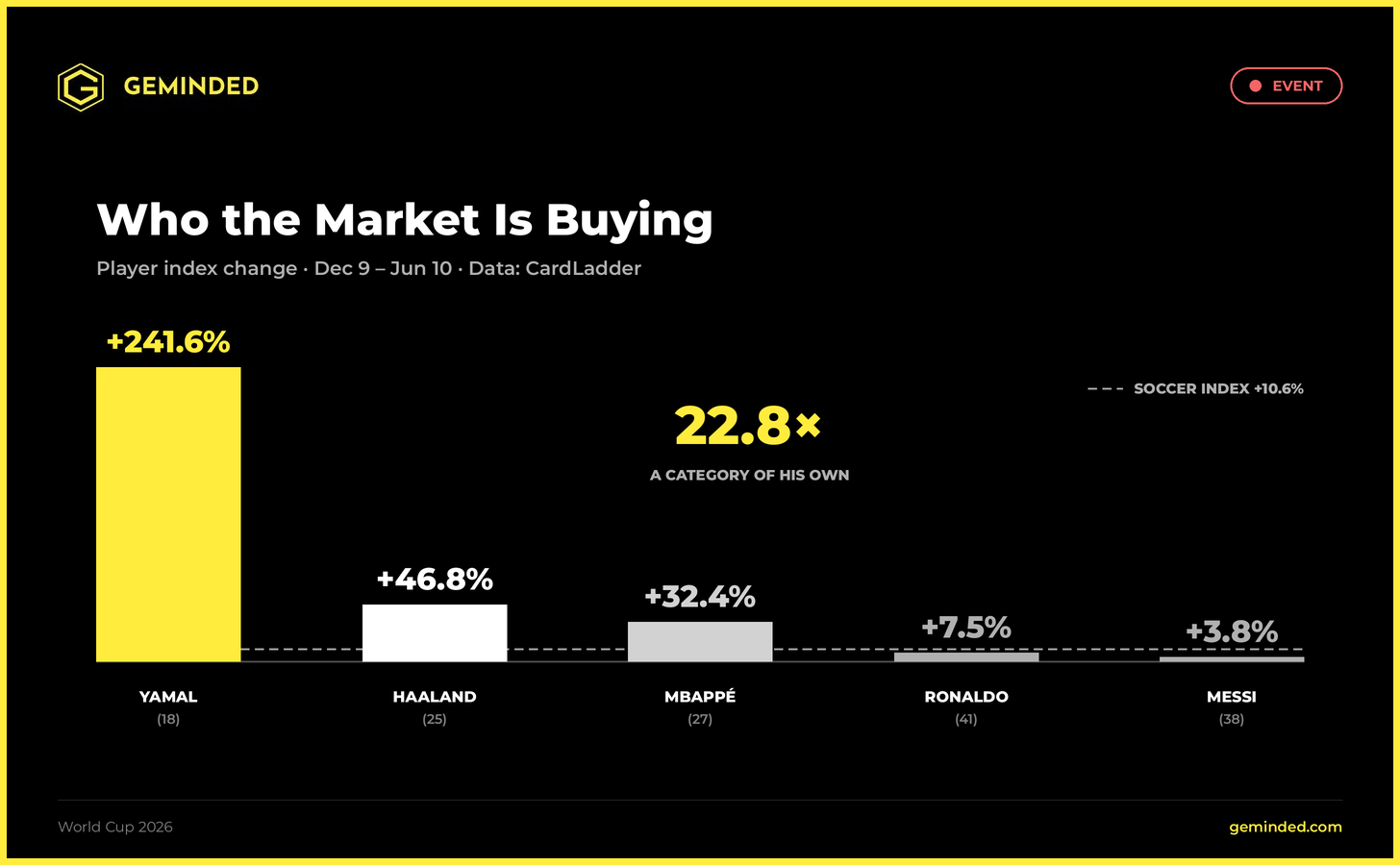
Five names, the same six-month window, Card Ladder player indexes:
• Yamal (18): +241.6%
• Haaland (25): +46.8%
• Mbappé (27): +32.4%
• Ronaldo (41): +7.5%
• Messi (38): +3.8%
• The segment as a whole: +10.6%
The ranking almost exactly tracks age — in reverse. The one exception sits at the tail: forty-one-year-old Ronaldo has leapfrogged Messi, three years his junior. And that exception gives the game away: age itself isn’t what’s being paid for. The market pays for a fresh story: how many chapters are left, and how big a stage they’ll play on. And on that basis, the five split into four tiers.
The Heir. Yamal is a category of his own — and he has the most of both. At eighteen he goes to his first World Cup leading Spain, the bookmakers’ favorite; he turns nineteen on July 13, six days before the final. His market didn’t reprice — it rewrote the price list. And it did so despite an injury that will likely cost him at least the start of the group stage. At the bottom of the range: his base rookie Refractor, the 2023-24 Topps Chrome UEFA Club Competitions #64. In a PSA 10 — the top grade, 476 of them in existence — it went from $500 to $2,130 in six months. At the top end: four of his cards have cleared $100,000 in the past fifteen months, with the record held by a signed Superfractor — a one-of-one — from the Euro Topps Chrome set, at $396,500 in June 2025. And in between, demand nobody else on this list has: Card Ladder indexes just 29 Yamal cards so far — against 92 for Haaland — and they’re still worth nearly four times as much combined. On top of that, his cards trade nearly twice as many dollars per day as Mbappé’s and Haaland’s put together.
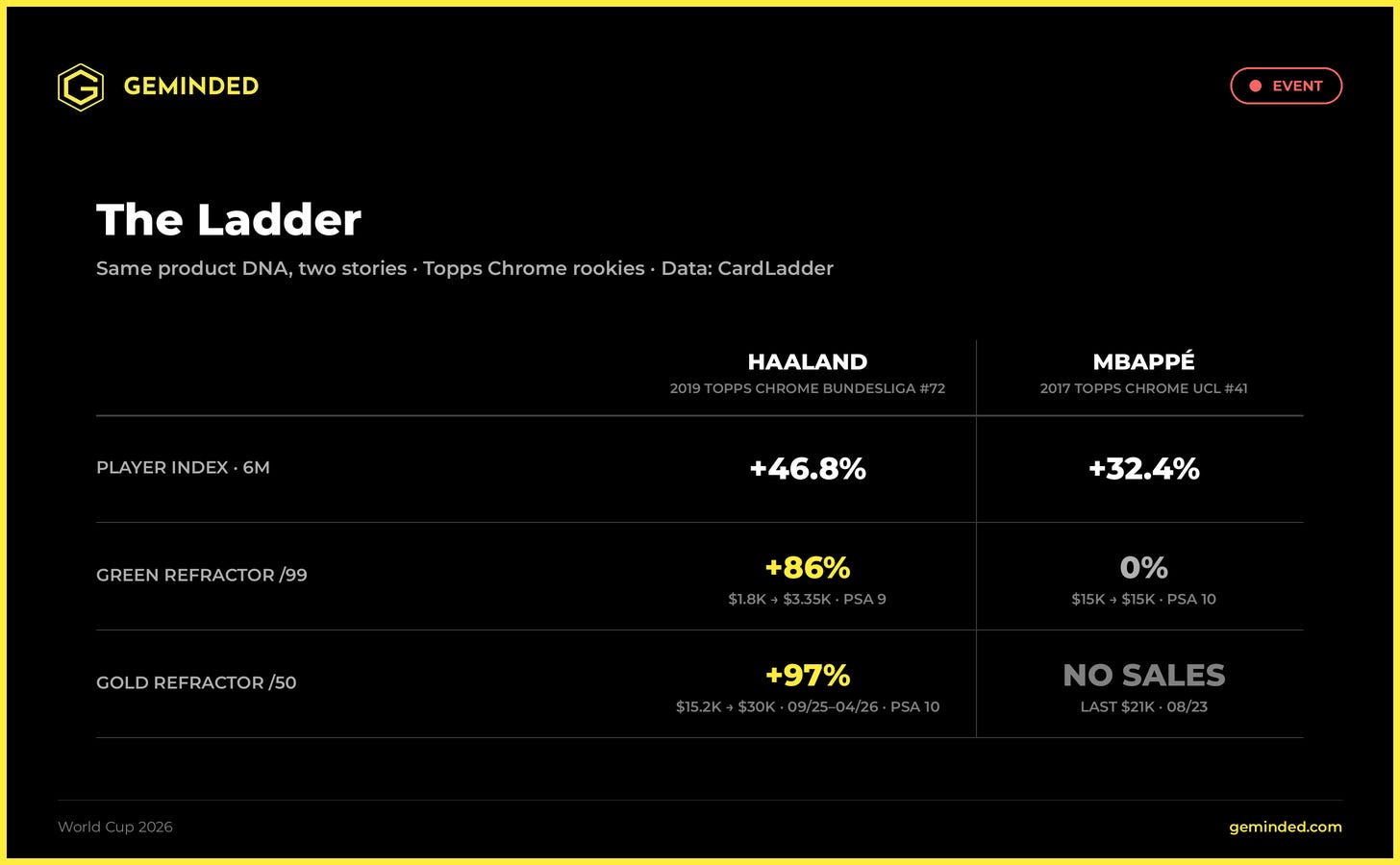
The New Chapter. Norway hadn’t reached a World Cup since 1998, so Haaland, at twenty-five, is heading to the first major tournament of his career. And the demand comes from the top down. Every rookie line has a scarcity ladder — from the base version up to limited parallels, where /99 means 99 copies made. His 2019 Topps Chrome Bundesliga line (#72) over the past six months:
• Refractor (PSA 10; the base, most-traded version): from $2,500 to $2,640, +5.6%
• Green Refractor /99 (in PSA 9, where the card actually trades): from $1,800 to $3,350 on three sales, +86%
• Gold Refractor /50 (PSA 10): from $15,200 to $30,000 between last September and this April, +97%
A handful of trades? Sure. With scarce cards, the small sample is the point, not a flaw in the measurement.
The Rerun. Mbappé — world champion in 2018, a hat-trick in a lost 2022 final, leading a favorite at twenty-seven — is the most valuable warning on this list. His Green Refractor /99 from the key 2017 Topps Chrome UEFA Champions League line (#41) jumped from $9,900 to about $15,000 last autumn — but everything was rising then; it rode the whole market, no merit of its own. Since December the segment has added another ten percent and Haaland’s scarce pieces tens of percent. Mbappé’s own index is up 32.4% over the same six months — but the growth lives at the cheap end of his range: base versions and World Cup-branded cards, most under $1,000, up anywhere from 45% to more than 130% over the past three months. At the top, where status is decided, almost nothing is moving:
• Green Refractor /99 (PSA 10): $15,000 in December, $15,000 in May — zero
• Purple Refractor /250 (PSA 10): first sale $5,150 in March, last $4,500 in May — eight in total, scattered between $4,500 and $5,433. No direction.
• Gold Refractor /50 (PSA 10): last sale $21,000 in August 2023 — not a single one since
• Kaboom! (2018 Panini, PSA 10): $16,669 in February, $16,000 in May — six sales in total, swinging between $13,800 and $16,200 along the way. Busy, but no net move.
Same product line, same parallel, same window: Haaland’s /99 +86%, Mbappé’s /99 0%.
Standing still in a rising market isn’t stability — it’s losing ground.
The difference shows at the top of the ladder. A fresh story gets even the scarcest pieces repriced — six-figure sales for Yamal, a doubled Gold for Haaland. A rerun’s top stays put, waiting for a story that no longer comes.
The Last Dance. Messi and Ronaldo are closing the same story at two different speeds. Messi’s market is still by far the biggest — his indexed cards are worth $79 million, more than the other four put together — but his wave has already passed. In late summer and autumn 2025, a run of record sales swept through his market. The wave was crowned by his 2004-05 Panini Mega Cracks #71 rookie selling for $1.5 million in a PSA 10 — no soccer card has ever sold for more. The index shot to nearly 177,000 points, then corrected and settled around 130,000 — more than double where 2025 began. Today’s +3.8% isn’t apathy; it’s the echo. Ronaldo went the other way: up 22% off his January low, the only one of the five closing the window right at his peak — 141,594 points. Two speeds, one logic: a farewell doesn’t go on sale.
One note on method, because the whole piece rests on it: indexes summarize, sales testify. That’s why I show both everywhere — and when it’s a handful of trades, I say so straight out.
What Qatar Did
Now flip the whole thing around. Qatar 2022 was the biggest catalyst this sport has — and it landed in the middle of the biggest slide the hobby has ever seen. The covid bubble was deflating: the soccer index lost 67% between its 2021 peak and its 2024 trough of 6,480 points. The tournament didn’t slow that avalanche by a single week; the index kept falling straight through it.
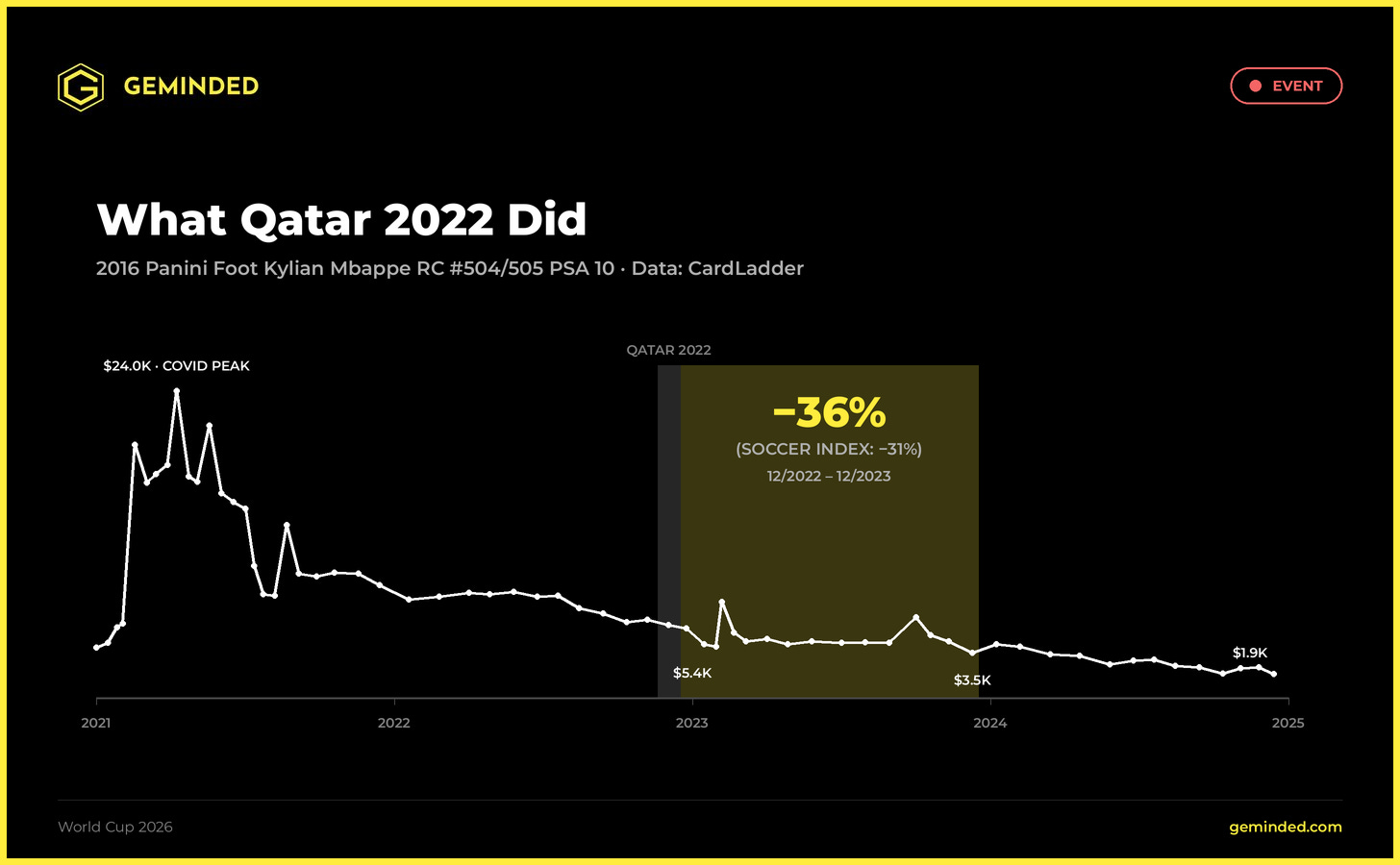
And the winners? Messi lifted the trophy — and his market just shrugged. Twelve months after the final whistle his index stood 1.2% above where it had started — it never left a 36,000–46,000 band. Mbappé scored a hat-trick in the final and took the Golden Boot — and his index still gave back 27% in the year that followed. His flagship rookie in PSA 10 — the 2016 Panini Foot sticker (#504/505) — spiked briefly during the tournament, then lost 36% over the next twelve months. The segment over the same window: −31%. The honest read: the regime did the damage — and the biggest stage in sport couldn’t buy anyone a repricing. The world champion got a year of treading water. The Golden Boot got minus twenty-seven.
And at the very top? Mbappé’s Gold Refractor /50 from that same 2017 Topps Chrome UCL line: $26,400 in March 2023, $21,000 in August — then silence. Almost three years without a single sale.
After the tournament, it wasn’t just prices that dried up. Liquidity did.
When the story fades, it won’t be the price on your screen that hurts — it’ll be the buyer who never shows up.
I don’t know this cycle only from charts. That beaten-up rerun card above — the same Mbappé Panini Foot rookie sticker — isn’t an anonymous example. Last autumn, three years after Qatar, I bought it — precisely because the decline had already done its work. This spring, before kickoff, I sold it — for roughly half again what I paid. Not because I’m smarter than the market. I just bought when nobody wanted the story, and sold as the tournament was bringing the attention back.
What Follows — and What Doesn’t
2026 isn’t 2022, though. The regime has flipped: the market has been recovering since early 2025, so this time tournament demand has a chance to actually show up in prices instead of drowning in them. The data does not say everything will be a third cheaper in January.
What it does say is asymmetry. Whoever buys today is buying after six months of gains, at the top of the story, in a regime nobody can forecast for the second half of the year. And one detail straight from the stat boxes: Messi, Haaland and Mbappé all close the window just under its highs (−4.7%, −4.2%, −2.6%), the segment −1.4%. That’s not a decline — it’s lost momentum. The market isn’t accelerating into kickoff. It’s standing still.
Whoever holds, on the other hand, is looking at the most liquid window of the entire cycle: more buyers, more bids and more attention than this segment will see again before the 2030 World Cup. And one more memory from last time — the only things that stayed above water were the unrepeatable pieces. Everything replaceable bled with the market.
Scarcity won’t always protect you. Unrepeatability might.
The Verdict
Holding? The tournament is a window to sell, not a reason to fall in love. Love for winners is the most expensive emotion in a portfolio — I wrote about it last time.
Buying? The big buying window historically doesn’t open at kickoff — it opens months after the final. There are exceptions even now: an injury has Bellingham priced well below the role he’ll play this summer — England’s most important player. And Vinícius — one of the five or six most valuable footballers in the world, per Transfermarkt — has cards that never caught up with that status. But the real discounts start once the attention drains away — that’s exactly how it went after Qatar. And if you’re buying now anyway, at peak attention, at least know which tier you’re buying into: the heir, the new chapter, the rerun or the last dance.
Watching? The best-documented boom-bust cycle in the hobby’s history is about to run right in front of you. Take notes. The next big window arrives with the 2030 World Cup — sooner than you think.
Everyone buys the World Cup. The sellers are the ones who read history.
Which tier are you buying into?
And would you still buy it six months after the final?
Reply directly to this piece — I read every response.
— Geminded