

At the end of my Kobe piece I said The European View would come next. The series is still on. But the Pokémon market has moved so much in the past few weeks that I felt I had to write about it first.
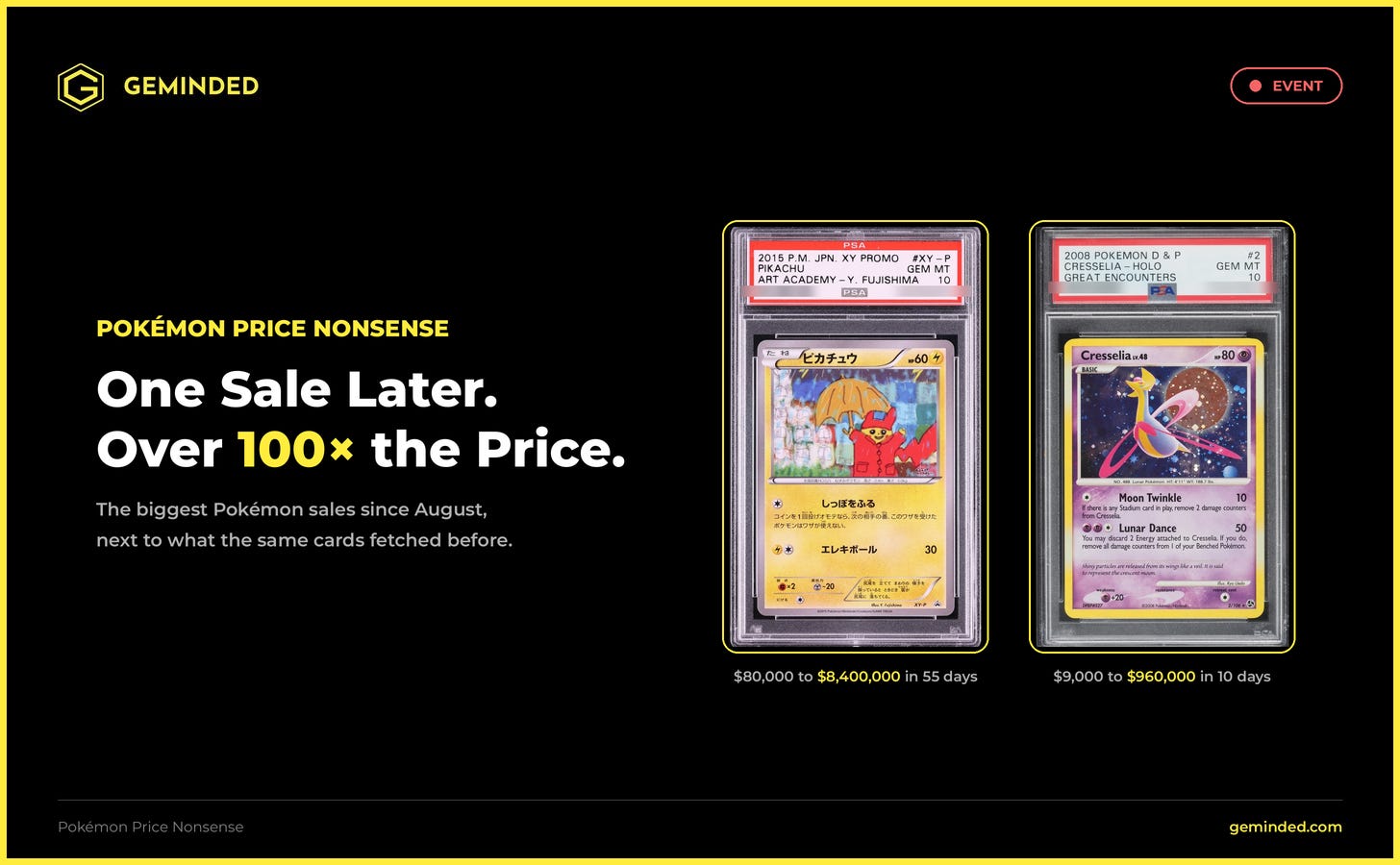
On September 28 a 2015 Japanese Art Academy promo Pikachu, PSA 10, sold for $8.4 million. Its previous sale, in August, was $80,000. This piece is about one question: why are Pokémon prices moving faster than anyone can price them?
How long a comp lasts
I pulled the ten biggest Pokémon PSA 10 sales I could find on Card Ladder since August 1 and looked up what each card had sold for before. Six of the ten had a previous sale within three months.
The Rayquaza climbed in steps: $9,200 in August 2025, then $180,200 on August 6 this year, $238,500 on August 27 and $791,622 on October 1.
Prices don’t only go up. A Skyridge Umbreon sold for $180,000 on October 5, and the next copy went a day later for $142,655, a fifth less.
A year without a sale
The other four of the ten had gone a year and a half or more without a recorded PSA 10 sale. I have added a fifth card, the Tyranitar Prime from Unleashed, because I had been following it myself.
For these five, the most recent comp was more than a year old by the time the card sold. In September I analyzed the Tyranitar in detail: 12 PSA 10s out of roughly 1,300 graded copies, a gem rate under 1%. My budget was $35,000. It sold for $252,000.
Pop 12, pop 7, pop 129
The Tyranitar has a pop of 12. Earlier in September, two cards with a pop of 7 sold a week apart. A 2007 Honchkrow LV.X from Secret Wonders went for $50,400 on September 14. The Garchomp LV.X above went for $900,000 on September 21. And the Skyridge Umbreon from earlier has a pop of 129 and still trades in six figures.
So is it the pop, the Pokémon, or just the week? I can’t separate them. Low pop helps, but on its own it doesn’t explain either table.
Why now
Before the why, there is a more basic question: is all of it real?
Three of the eleven later sales in the tables are marked as confirmed paid, including the $2.7 million Torchic. For the other eight I can’t see whether the money has actually moved, and the $8.4 million Pikachu I started with is one of them. If some of them never get paid, I’m looking for reasons behind prices that never existed.
If the sales are real, I have three explanations and no proof for any of them.
The anniversary. The 30th Celebration set came out on September 16. Did it pull collectors back to the old cards?
Peak popularity. Is this simply Pokémon at the peak of its popularity worldwide?
A structural change. Have last year’s prices simply stopped being the reference point?
I can’t tell which of these is doing the work. What I can control is how I sell.
My two sales
My own cards trade far below these prices, and this autumn the market still outran me twice.
On September 12 I sold a 1999 Base Set 1st Edition Magneton, PSA 10, for $29,000 through Best Offer on Fanatics Collect. A week earlier another copy had gone at Alt for $27,450. I was happy to let it go: the back had some whitening I hadn’t noticed when I bought the card. Today I’d guess a copy brings $40,000 to $50,000, maybe more.
It was my second attempt to sell it. In June a buyer agreed to about $28,000 and never paid, so I know an unpaid sale isn’t just a theory.
On the evening of October 4, my time, a red Prism Blastoise from the 1996 Bandai Carddass set, PSA 10, stood at $5,750 in a Fanatics Collect Weekly Auction. So did the green variant. My own red copy sat in a fixed-price listing at $29,999, and I didn’t raise it.
About ten hours later the red one closed at $40,800, seven times that bid. Within 30 to 40 minutes of the close, someone bought my copy at full price, without making an offer. A month earlier I had turned down two offers of $6,000 to $8,000.
Both were sold at a profit, and both were too cheap.
What I’m doing about it
This week I moved two cards from fixed-price listings into a Fanatics Collect Weekly Auction that runs from October 9 to 19. Both are holo Charizards in PSA 10, with pops between 150 and 250. It won’t be anything spectacular. I just want to see what this market really pays right now, and ride the wave with the little I have.
Three rules for a market like this
In this market, a comp can go stale in days. The Cresselia in the first table sold for $9,000 on September 25 and for $960,000 ten days later.
Reprice fixed-price listings before a big auction of the same card closes. My Blastoise listing sat $10,801 below the auction result when it sold.
Pop alone doesn’t set the price. Two pop-7 cards sold for $50,400 and $900,000, a week apart.
On September 25 the Tyranitar sold for $252,000. What is it worth today? I have no idea, and I don’t think anyone else does either.
Have you sold a card in the last few weeks that you would price differently now?
Reply directly to this piece — I read every response.
Next week: part one of The European View, a four-part series on what it really costs to collect from Europe.
— Geminded
Note: I read the data for both tables on October 8. That evening, US time, Alt’s weekly auction closed; in Europe it was already the morning of October 9. By the time you read this, my top ten may already be out of date.