

Late summer 2025. I’m coming back from a work trip abroad. Out of curiosity, I scroll through a few recent auction results. A card I sold three years ago is, at that moment, worth more than twenty times what I sold it for. I sit there, stunned. I’d boarded the right train — and clearly got off a few stops early.
This is the story of two cards — one I sold sooner than I should have, and one I bought this year. And of a mistake I don’t want to repeat.
Through Geminded I want to write about sports and other cards as a serious alternative asset. Analytically, on a data-driven basis. With my own portfolio on the line. From a European perspective — one this category still badly lacks.
No speculation without data, no hype, no clickbait rankings.
Specific positions, specific reasoning, specific deals — including the ones that went wrong.
This is the first of them.
Late 2020 — the covid-era boom
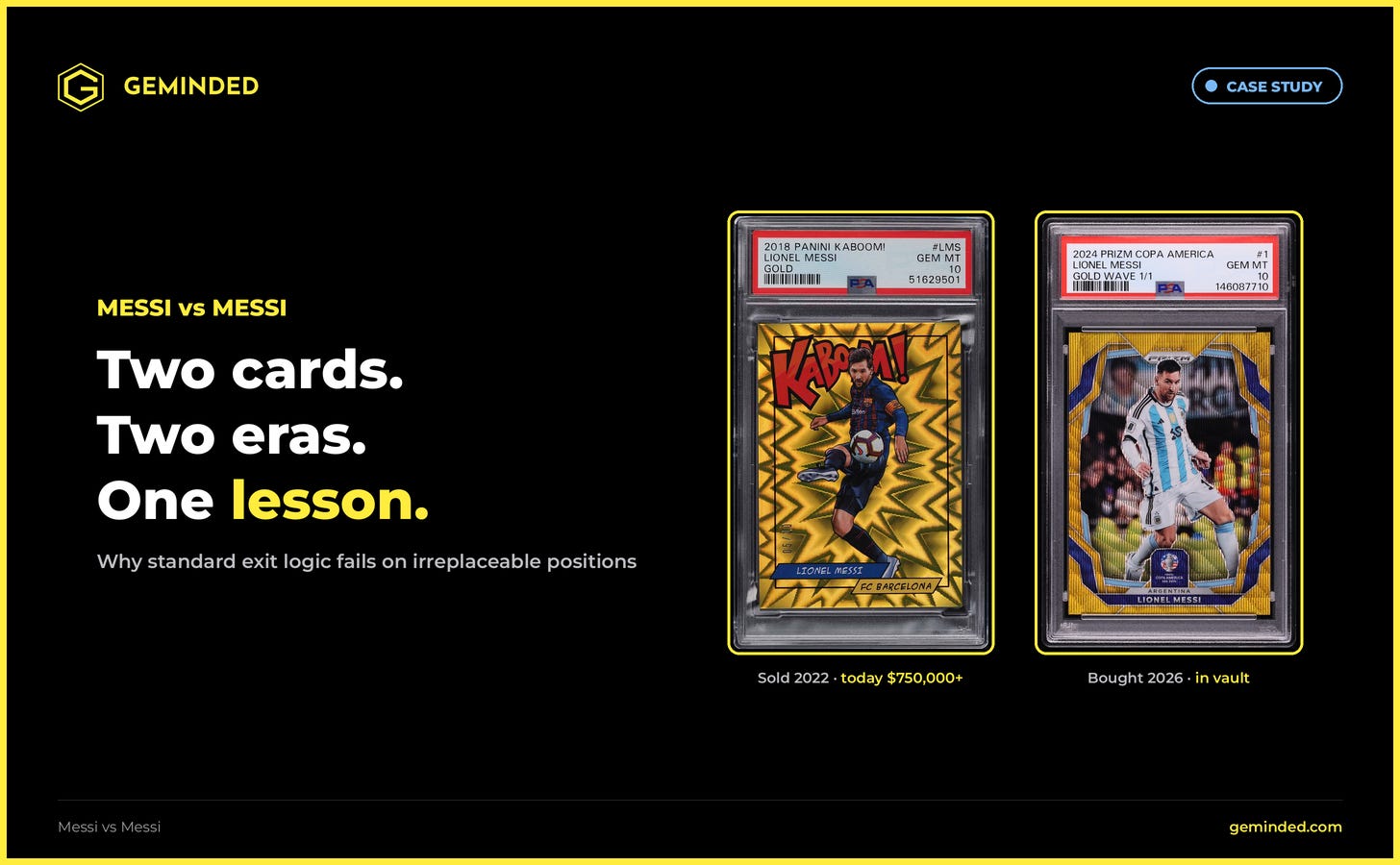
The collectibles market is climbing month after month. I bought a 2018 Panini Kaboom Messi Gold — the parallel limited to 10 copies, my copy graded PSA 10 (Pop 3). Kaboom was already an established insert in basketball, but in other sports it was only just gaining traction. The price wasn’t small, but I knew right away it was a winner.
Late 2022 — the post-covid slump
The covid bubble has burst and the whole collectibles market is falling — soccer cards included. The World Cup in Qatar is coming and Argentina advances to the knockout stage. I believe the price will go up. I sell.
I make money — and not a little — but far below my original estimate. Before the auction I’d had an offer of $50,000. I turned it down, figuring the auction would bring more. It didn’t (by more than a third). I still came out ahead on the sale, but only because of an exceptionally good buy two years earlier.
Late summer 2025 — late comps
Over the summer of 2025 a message landed on my WhatsApp asking whether I still had the card. And shortly after, comparable sales started to appear.
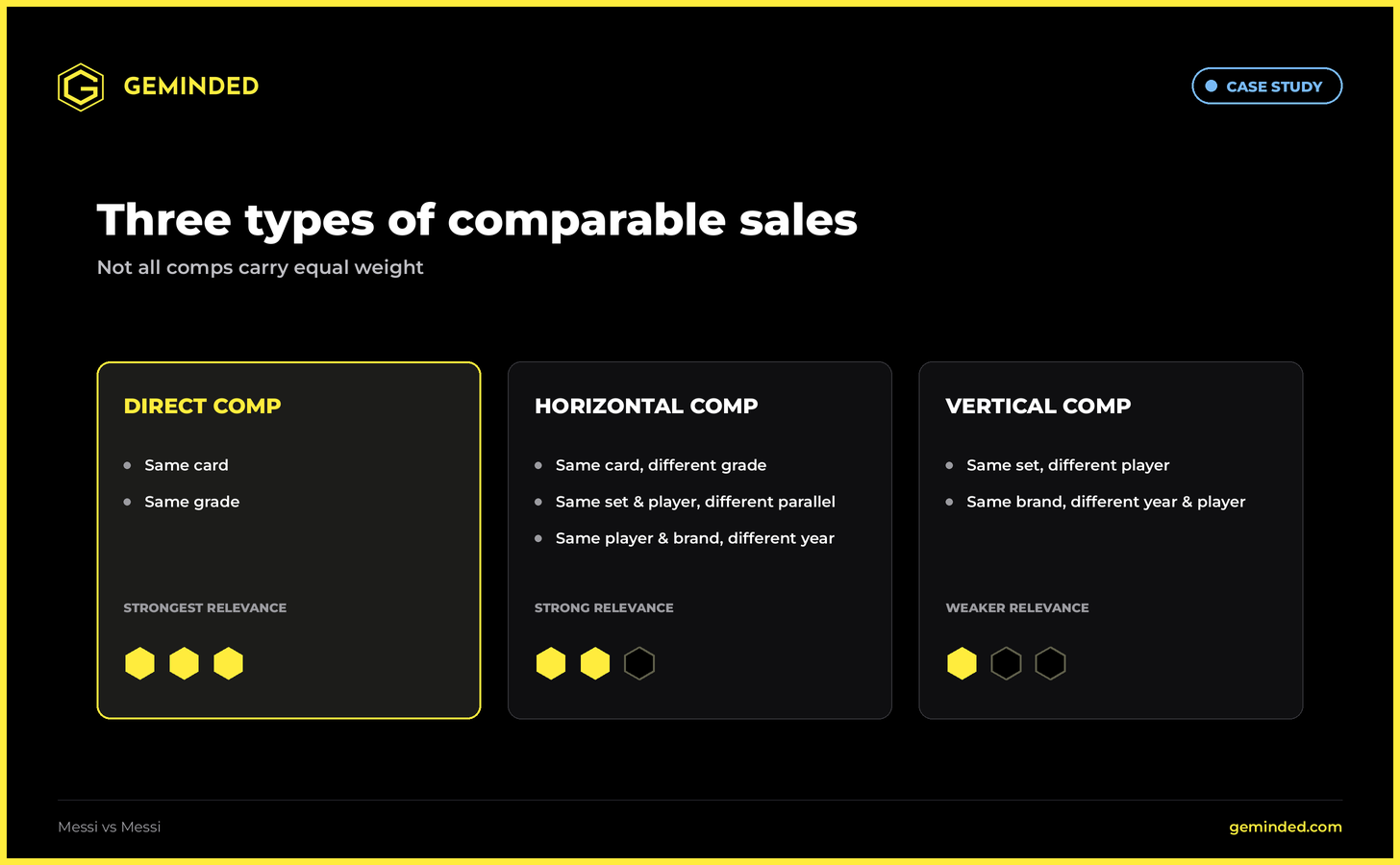
A direct comp — the same card selling again — hasn’t happened for mine since 2022. A horizontal comp (same card, different grade): a 2018 Messi Kaboom Gold in PSA 9 sold for $385,084 in a private sale in August 2025. A vertical comp (same set, different player): a 2018 LeBron Kaboom in BGS 9.5 sold at Goldin for $353,800 in November 2025.
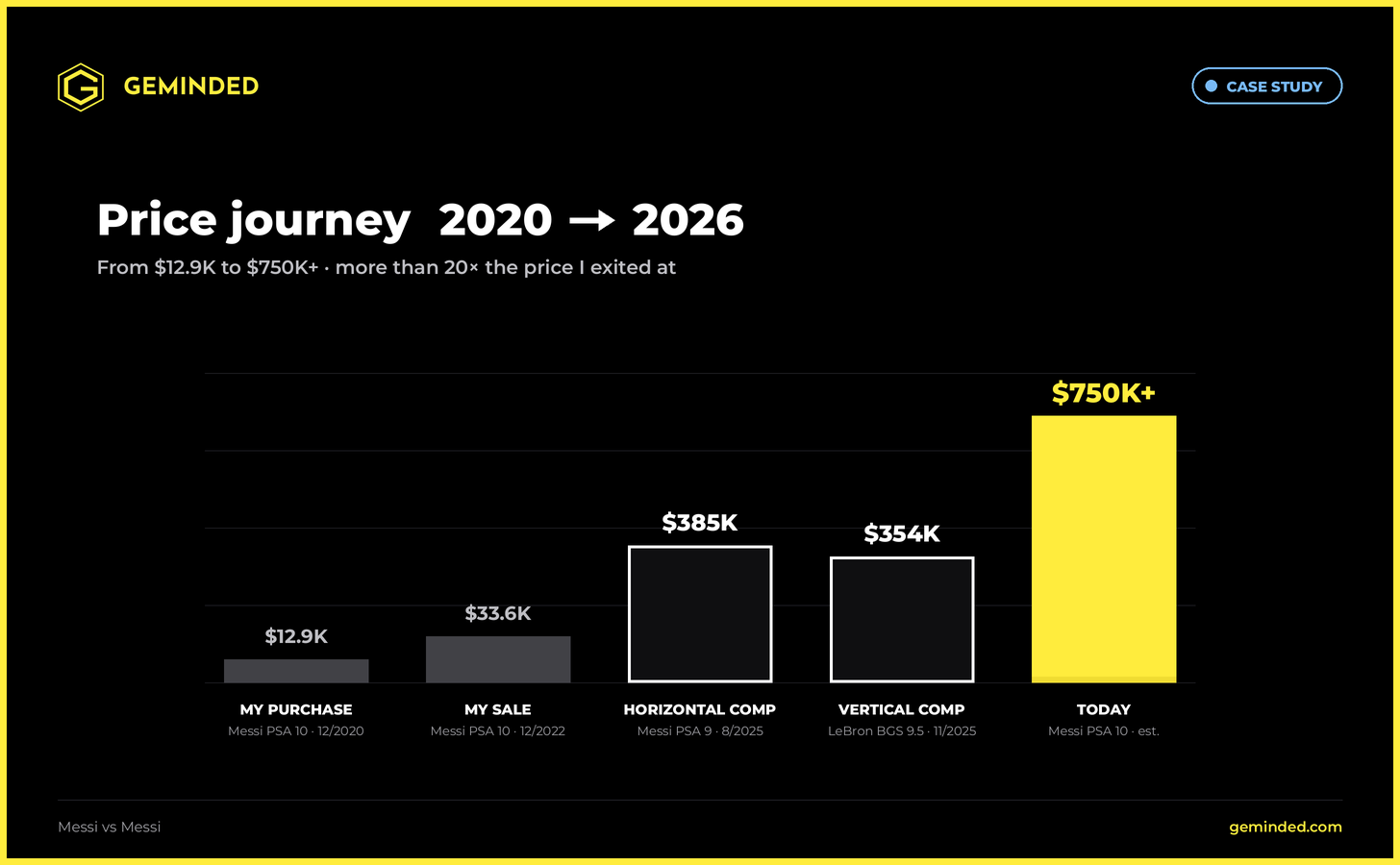
At that point I can see my card is worth well above what I sold it for. Maybe somewhere around $750,000 or more.
The proceeds from the 2022 sale went exactly where I needed them at the time. A specific personal goal that couldn’t be postponed and that I couldn’t have afforded without that exit. So I don’t question the sale itself.
What can be questioned is how I arrived at it. And the price I paid for getting there.
What Kaboom taught me — why standard exit logic fails on scarce cards
Scarce cards don’t trade on the same logic as common ones. And when you sell them with a specific goal in mind, you usually pay for that difference — with a delay.
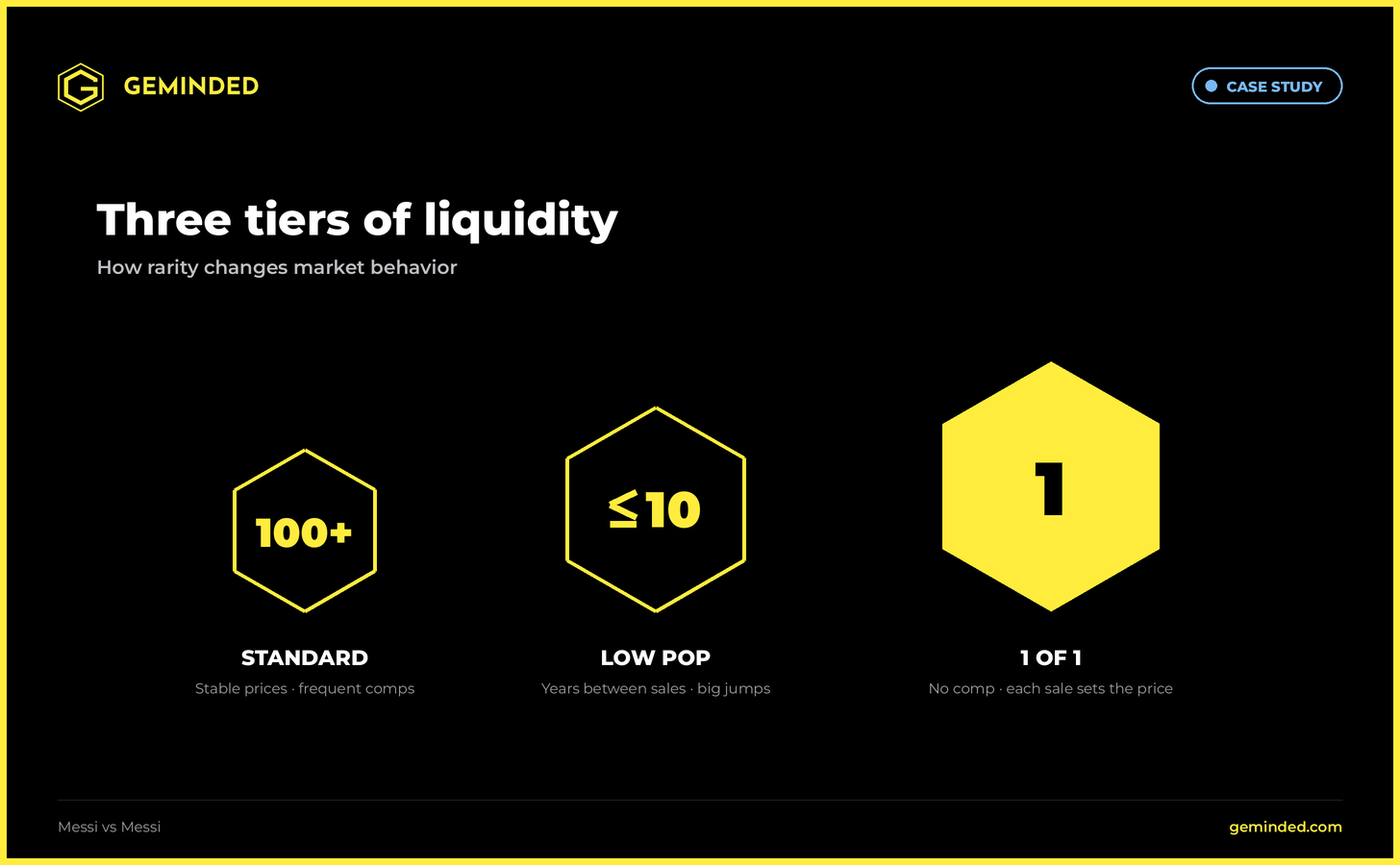
A card with a population in the hundreds behaves like standard goods — more copies, stable prices between sales, frequent comps.
A card limited to 10, with a population of 3 in the top grade, is a thin market — fewer holders, years between sales, bigger price jumps.
A true 1of1 has nothing left to compare against. Every sale is its own benchmark.
The consequence for exit logic is this. For scarce positions it isn’t enough to set a target price and sell when it’s reached. You can’t buy the same card back. The target you set today may not match what the card is worth in three years. That’s true of every card — but with low Pop it’s true many times over.
It doesn’t mean every such sale is a mistake. It means that for irreplaceable positions, a target price is a weaker guide than you think at the moment you set it. The narrative around the card shifts — and your exit plan should shift with it.
February 2026 — second attempt, different rules
The first test of that principle. I’m back, and this time without compromises.
In my investment collection I have a new Messi: a 2024 Panini Prizm Copa America Gold Wave PSA 10. The set has four 1of1s in total (Black, Nebula, Black Pulsar, Gold Wave), and mine is probably tier 4 among them — the lowest priced of the four (given the color, the pattern, and market preference). Even so, it’s the only card that exists in this exact form.
Gold Wave isn’t anywhere near the same price league as Kaboom Gold. Kaboom Gold sits far higher in Messi’s catalog. What both cards share is how they trade — both sell against a key narrative event (back then the soccer World Cup in Qatar, this year the World Cup in the US, Mexico and Canada).
For the Copa America Gold Wave, no prior PSA 10 sale exists — the only transaction in this card is my own purchase. Within the same set, though, there’s a single horizontal comp: another 1of1, the Black Prizm in PSA 9, sold at auction for $68,320 in December 2024. The Card Ladder Value for this variant today (05/26 — author’s note) sits around $180,000.
But these numbers need to be read with caution. The Black Prizm sold shortly after the 2024 set’s release, when prices on freshly released cards tend to be inflated by early hype. The genuinely realizable price today may not match the CL Value. It isn’t a firm benchmark — a reference point, nothing more.
Exit rules for this position — what I’m doing differently
Two rules I’m trading Gold Wave by. I used neither on Kaboom.
First: no auction format. Not now, at least. Even with good preparation — CL Value, recent comps, the player’s index — an auction on a card with no direct or horizontal comps carries residual risk. The final price can badly undershoot a calibrated estimate, and there’s no backing out without a reputational cost.
A Best Offer (BO) format lets me decide as I go. If the right offer doesn’t come, the card stays in the vault.
An auction may make sense later, once comparable sales accumulate — another 1of1 from the same set, or cards from similarly styled sets.
Second: hold, not a bet on a single catalyst. If the World Cup doesn’t bring the right exit, I keep the card. Copa America 2028. Messi’s gradual exit from the national team. The end of a career, usually followed by index stabilization and another growth phase. The narrative continues. There’s no rule that I have to sell just because a tournament happened.
What can go wrong — the risks I’m not ignoring
Liquidity in this price class is low. Globally it’s a few hundred serious buyers and a handful of institutional collectors. Most in the US, some in Asia. And Europe? There’s certainly no line of cash-ready buyers forming here.
Misreading Messi’s exit. The “last big tournament” thesis assumes WC 2026 will be the finale of Messi’s national-team career. He’s announced — and changed — his intention to leave before. If he keeps going — Copa America 2028, where he’ll be 41 — the peak narrative moves forward. The exit window for Gold Wave slides out, and I hold the card longer than I’m currently counting on.
Current position
• The card is in the vault with an active BO listing on Fanatics Collect.
• I’m waiting for the right offer; I’m not actively chasing a buyer.
• For a 1of1 with no direct comp, a stop-loss doesn’t apply.
For irreplaceable positions, the asymmetry holds. Sell too early and the gap between your sale price and the future value can never be closed — you can’t buy the same card back. Sell too late and you only lose a slice of the peak, but you held the card the whole time.
I could no longer say yes to that 2025 offer. The card was gone. What I do control is not repeating the same mistake I made with Kaboom. And understanding why I made it in the first place.
Has it ever happened to you that you made the right decision — and still regret it to this day?
And who do you think wins this year’s World Cup — and why exactly Argentina?
Reply directly to this piece; I read every response.
In the next article we’ll look at the disposition effect — the cognitive trap that systematically pushes investors to sell winners too early. The trap I walked straight into with Kaboom.
— Geminded
Update — August 31, 2026
I asked above who wins it. Spain beat Argentina 1-0 in the final, so much for that. The card didn’t sell during the tournament and is still listed — though holding was never really tested, since nothing forced the decision either way.
Messi has now retired from the national team. He wrote the statement two days after the final and published it six weeks later. That closes the question this piece left open, and it makes the 2024 Copa América his last trophy in an Argentina shirt.
It also compresses the timeline I described. I had the end of his international career as the last step, somewhere past Copa América 2028. It arrived two years early. The card stays listed either way — the point of rule two was never to sell on the tournament.