

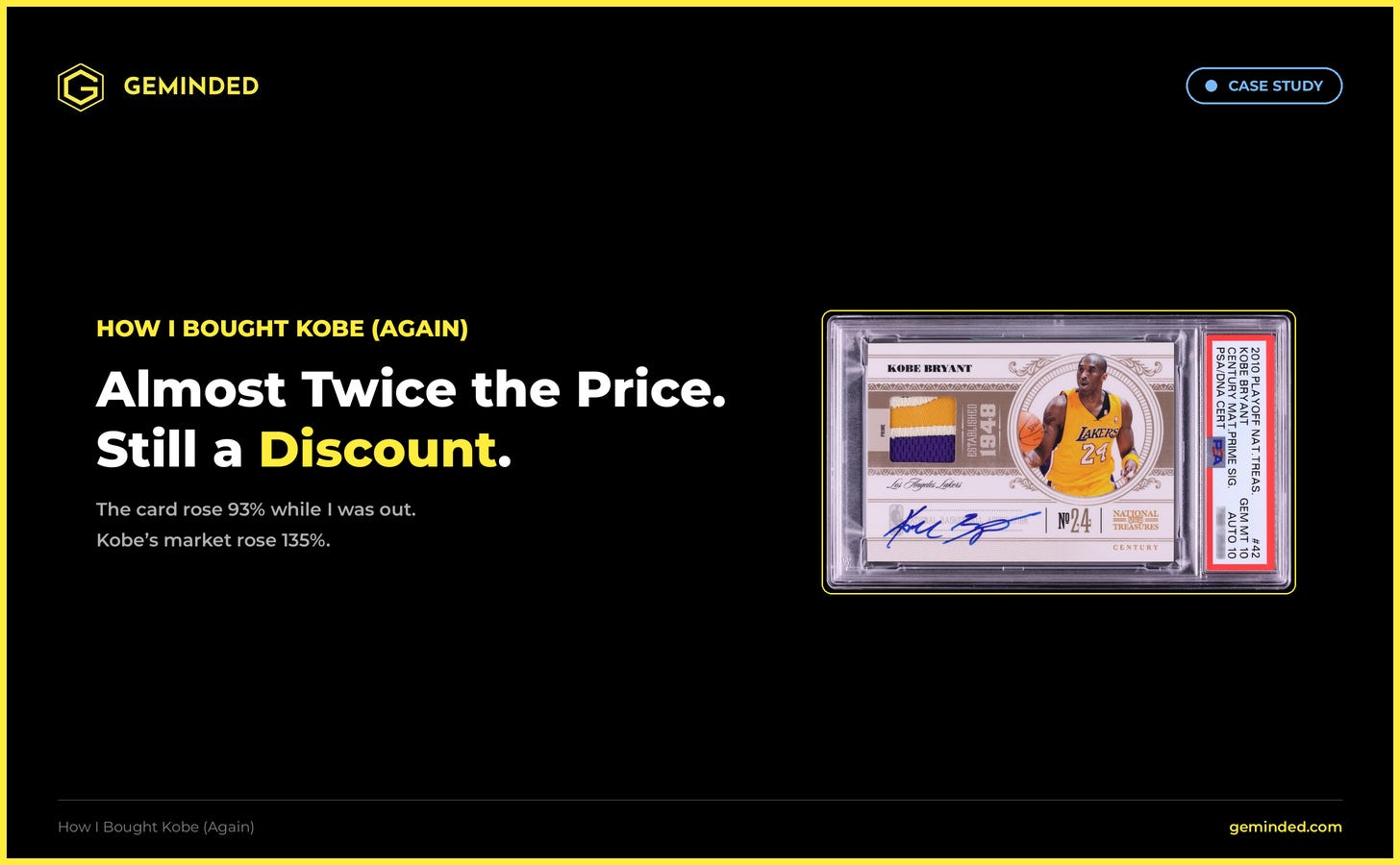
In September 2025 I bought a 2010-11 Playoff National Treasures Century Material Prime Signatures #42 Kobe Bryant, numbered 24/25 and graded PSA 10 with a 10 autograph. Four weeks later I accepted an offer and sold it at a profit. On September 25, 2026, I bought it back for almost twice what I had sold it for.
This piece is about one question: when you buy back a card you sold, should your old sale price matter?
A rule with one exception
My rule for investment cards is simple: you never step into the same river twice. Once I sell a card, I don’t buy it back. I did regret this sale, and I’ve written before about selling a Messi Kaboom too early, in Messi vs Messi. This time the card came back up for sale.
The exception: a rebuy has to pass the same test as a first buy. Would I buy this card today, at this price, if I had never owned it? My old sale price has no place in that question. What counts is the card and the market.
What the card has
24/25. Kobe wore 24. Of the 25 copies, only one carries his number. It’s the main reason I bought this card, both times.
PSA 10, auto 10. PSA has graded two of the 25 copies 10/10.
Eye Appeal A from Fanatics Collect, added since I sold it. An A puts the card’s eye appeal in the top 30% of copies at that grade.
What it doesn’t have is a big patch; the swatch is small, with three colors. Apart from the Eye Appeal A, it’s the same card I sold. What changed is Kobe’s market.
What Kobe’s market did
Card Ladder’s Kobe index tracks 1,056 of his cards. Against it, the two halves of this story look like this:
I sold into a jump that was mostly the card’s own, and bought back after Kobe’s market had outrun the card. Both card prices are in its sales history. For each trade I use the nearest index reading, except on auction day, when the index jumped almost 10% and I can’t tell how much of that was my own purchase.
Had the card simply followed Kobe’s market after I sold it, it would have cost 2.35 times my sale price. I paid 1.93 times, about 18% less than that. The index tracks Kobe’s market as a whole, not this card, so I use it only as that yardstick.
Conor Collects described a rising tide for 90s players in his August recap, naming Kobe, Jordan and Shaq as the stars pricing everyday collectors out. Through all of it, the card changed hands only on Fanatics Collect.
The same vault
I bought it in a Fanatics Collect Premier Auction, sold it through Fanatics Collect Buy Now, and bought it back in another Premier Auction. It may never have left the Fanatics Collect vault.
Buying, selling and holding without the card ever moving is how Fanatics Collect is set up. It even waives the seller fee if you take your payout in FanCash, as long as you’re an eligible US seller. I’m not one.
What would make this a mistake
None of this guarantees the rebuy will work.
Few buyers. The card has four recorded sales in three years, and three of them are mine. At this level it rarely trades, so when I want to sell, I may have to wait or accept less.
The market. I bought when Kobe’s index was at its highest in eleven months. If Kobe’s market falls back, the card could fall with it.
The grade. Only two copies have been graded 10/10 so far. If a third one gets there, mine stops being one of two, and the premium for the grade shrinks. The 24/25 stays unique, whatever PSA grades.
Rules for a rebuy
Measure your exit price against the player’s market. Divide your rebuy price by your sale price and compare it with the player index’s multiple over the same dates. Mine were 1.93 and 2.35.
Test a rebuy the way you test a first buy. The 24/25 is why this one passes.
Pay for the premium nobody can copy. PSA can grade another 10/10, but there will never be another 24/25.
Sell when an offer matches the card, and be ready to wait. This one has four recorded sales in three years.
Have you ever bought back a card you sold?
What made you do it?
Reply directly to this piece — I read every response.
Next: The European View, a four-part series on what collecting from Europe costs, starting with grading.
— Geminded